
Scale, Speed & Minimal Downtime
Straight talk from 38 years of fixing industrial slabs across North Texas — what really works when millions of square feet and tight deadlines are on the line.
“I’ve been crawling under slabs and driving piers into North Texas black clay since 1987. In that time, I’ve seen the DFW industrial market explode — and with it, some of the most complex, high-stakes foundation problems I’ve ever encountered. This post is everything I wish someone had told me in year one.”
— Bob Hargrove, Lead Specialist, UFE Foundation Repair
Let me be plain about something right up front: repairing the foundation of a 500,000-square-foot distribution center in Mesquite is not the same animal as leveling a strip mall in Plano. Not even close. The soil behavior is the same — that relentless North Texas expansive clay — but everything else: the engineering tolerances, the equipment footprint, the logistics coordination, the sheer cost of downtime — it’s a completely different world.
At UFE Foundation Repair, we’ve spent years refining our approach specifically for the industrial park environment. This post breaks down exactly what separates industrial-scale foundation work from standard commercial foundation repair, what you should be demanding from any contractor bidding your job, and how we keep your facility operational from day one to completion.
Why DFW Industrial Parks Are a Foundation Repair Category of Their Own
The DFW Metroplex sits on top of some of the most problematic soil in the entire United States. We’re talking about high-plasticity clay — Vertisols, if you want the technical term — that can swell up to 15% in volume after a good rain and shrink back just as dramatically during our summer droughts. That’s brutal on any foundation, but in an industrial park setting, the stakes are exponentially higher.
Think about what’s happening on these sites. You’ve got rack-mounted inventory stacked 40 feet high where a one-inch differential settlement can misalign a loaded bay. You’ve got forklifts and AGVs that need floor levelness tolerances tighter than most residential construction ever sees. You’ve got loading dock aprons that take punishment from 80,000-pound semis, day in and day out. And underlying all of it — the same black gummy clay that’s been torturing homeowners in Dallas since the first house got built here.
The Three Compounding Factors in Industrial Slab Failure
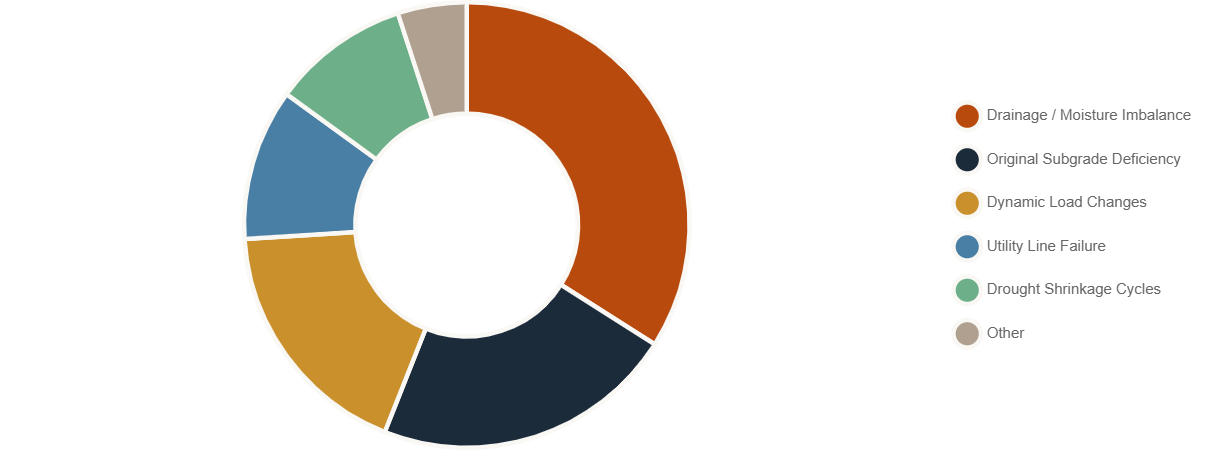
In my experience, industrial building foundation settlement in Dallas almost always comes down to three things working together:
Soil Moisture Variation
Drainage problems, broken utility lines, or even the irrigation from a neighboring property all feed water asymmetrically into the subgrade. One side swells; the other doesn’t. The slab cracks at the differential.
Dynamic Load Concentration
Industrial floors aren’t evenly loaded like a parking garage. Racking columns, battery charging stations, and dock pits create point loads that can exceed 20,000 lbs per square foot in localized areas — and the subgrade just wasn’t engineered for that over 30+ years.
Original Construction Variability
A lot of the DFW industrial stock built between 1985 and 2005 was constructed with varying levels of subgrade preparation. Some of it was excellent. Some of it… wasn’t. When those buildings start settling now, you’re playing catch-up with decisions made three decades ago.
Scale: Engineering for Large Industrial Footprints
When we get called out to assess a distribution center foundation repair job in Texas, the first thing I do before I write a single line of scope is commission a proper floor flatness and levelness survey. Not a visual walk. Not a four-foot level. A certified survey with a Dipstick or F-Frog profiler, generating FF/FL numbers across a grid of the entire floor.
That survey is the foundation of everything — no pun intended. It tells us not just where the low spots are, but the rate of change, which is what actually breaks racking and creates trip hazards. A gentle 2-inch overall settlement across 400 feet might be acceptable. A half-inch drop in 10 feet absolutely is not.
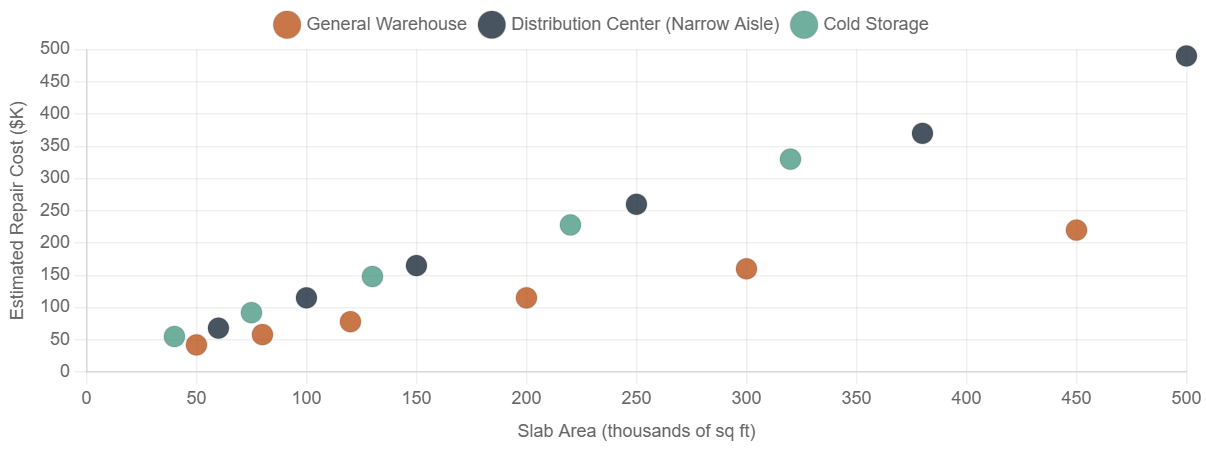
| Industrial Use Type | Min. FF (Floor Flatness) | Min. FL (Floor Levelness) | Primary Risk at Failure | Typical Pier Count / 100K SF |
|---|---|---|---|---|
| General Warehousing | 25 (ASTM E1155) | 20 | Forklift stability, pallet rack misalignment | 40–80 piers |
| Distribution Center (narrow aisle) | 50–60 | 40–50 | VNA forklift guide rail failure, racking collapse | 80–160 piers |
| Cold Storage / Freezer | 35–50 | 30–40 | Vapor barrier breach, rack tipping, door seal failure | 80–140 piers |
| Manufacturing / Assembly | 35 | 25 | Machine leveling loss, vibration amplification | 50–100 piers |
| Flex / Light Industrial | 20–25 | 15–20 | Trip hazards, door/dock misalignment | 20–60 piers |
Table 1: Floor tolerance requirements by industrial use type. Source: ACI 117, ASTM E1155, and UFE project database. Pier counts are indicative for DFW clay soil conditions.
Pier Selection: Pressed Concrete vs. Steel Piers at Industrial Scale
I get asked constantly which pier type is better for industrial applications. Honest answer: it depends on your specific soil profile and your goals. Here’s how I actually think about it on large industrial projects:
| Factor | Pressed Concrete Piers | Steel Push Piers | Helical Piers |
|---|---|---|---|
| Typical Depth (DFW) | 8–14 ft | 15–30+ ft | 12–25 ft |
| Load Capacity | Up to 60,000 lbs each | Up to 70,000 lbs each | Up to 60,000 lbs each |
| Indoor Installation | Excellent | Excellent | Good |
| Speed (piers/day/crew) | 8–12 | 4–6 | 4–7 |
| Slab Lifting Capability | Excellent | Excellent | Moderate |
| Cost per Pier (installed) | $350–$550 | $900–$1,600 | $800–$1,400 |
| Best DFW Application | High-volume, interior slab repair, budget-conscious projects | Deep settlement, exterior dock aprons, high rack loads | New construction, tiebacks, limited headroom |
Table 2: Pier system comparison for DFW industrial applications. Costs are 2024 estimates and vary by site conditions and access constraints.
The Floor Levelness Question: What Tolerance Should You Actually Require?
This is where I see owners and property managers get confused — sometimes with consequences that cost them far more than the foundation repair itself. Floor flatness (FF) and floor levelness (FL) are two distinct measurements defined by ASTM E1155, and both matter in an industrial setting. But they matter differently depending on your operation.
Speed: How We Compress Industrial Repair Timelines Without Cutting Corners
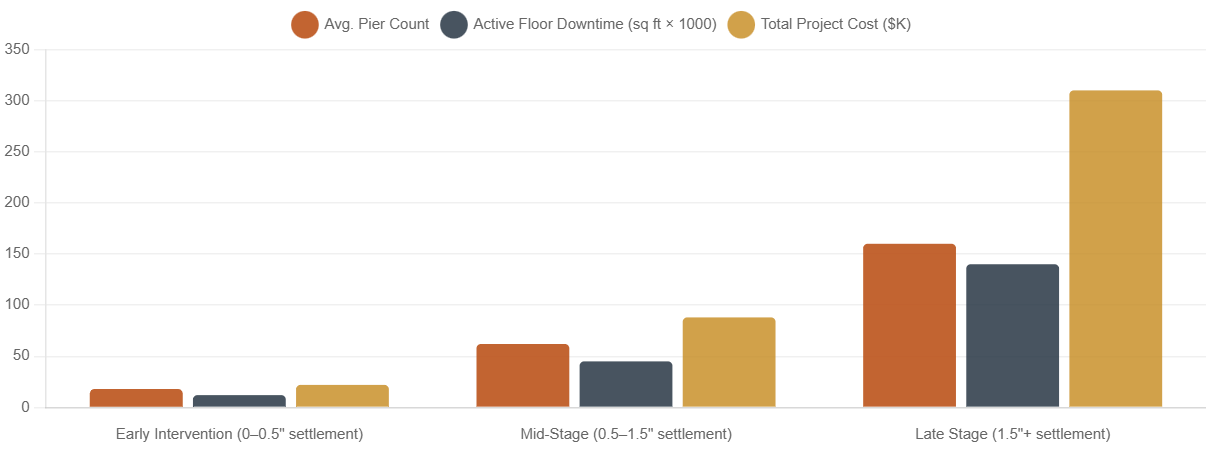
In 38 years I’ve learned that the fastest way to run an industrial foundation repair project over schedule is to show up without a plan. Conversely, the most effective time compression comes not from working faster — it comes from eliminating the dead time between phases.
On a standard residential pier job, you dig, you drive, you lift, you patch. Simple sequence. On a 300,000 SF industrial project, you’ve got concurrent crews, active forklift traffic in adjacent zones, structural engineer sign-off requirements at key stages, dock closure windows that have to be coordinated with shipping schedules, and concrete patch cure times that can’t be rushed without compromising the floor. Every one of those is a potential schedule killer.
On a recent 420,000 SF distribution center project in Grand Prairie, our pre-construction coordination with the facility’s operations team identified 14 separate scheduling constraints — including a Super Bowl weekend inventory surge — that would have added 6+ weeks to the timeline if we’d discovered them mid-project. Front-loading that conversation saved the client an estimated $340,000 in extended rack-down costs.
The UFE Industrial Repair Sequence
Here’s the general approach we use on large industrial park foundation repair projects in DFW. Every job is different, but this framework keeps projects moving:
| Phase | Activities | Typical Duration | Operational Impact |
|---|---|---|---|
| 1 — Assessment | FF/FL survey, visual inspection, soil probe, rack load review, drainage analysis | 2–5 days | Zero — no floor access required |
| 2 — Engineering | Pier layout plan, lift sequence engineering, structural sign-off | 5–10 days | Zero |
| 3 — Zone Prep | Rack clearance (by others or coordinated), core drilling, utility locating | 1–3 days/zone | Partial — zone by zone |
| 4 — Pier Installation | Hydraulic pier driving, slab lift, pier cap setting | 1–3 days/zone (8–15 piers/crew/day) | Partial — adjacent zones open |
| 5 — Surface Restoration | Core fill, crack injection, grinding, topping slab if required | 1–2 days/zone + cure | Partial — light foot traffic during cure |
| 6 — Verification | Post-repair FF/FL survey, documentation, client sign-off | 1–2 days | Zero |
Table 3: UFE standard industrial repair phase sequence. Phases 3–5 are executed zone-by-zone to maintain maximum operational area throughout the project.
Minimal Downtime: The Zone-by-Zone Approach
This is the part of industrial foundation repair that doesn’t get nearly enough attention in the trade press, but it’s the part that keeps property managers and tenants from losing their minds. The key principle is simple: never take down more floor area than you’re actively working in.
We divide large industrial slabs into work zones — typically 5,000 to 15,000 SF each, depending on the building layout and the racking configuration. At any point in the project, one or two zones are in active repair while the rest of the facility operates normally. Forklifts route around the active zone. Shipping and receiving continues. The lights stay on.
Drainage: The Hidden Driver of Foundation Problems in DFW Industrial Parks
I’ve been doing this long enough to know that if you fix a foundation without fixing the drainage, you’ll be back in two years. Maybe three. But you’ll be back.
In industrial park settings, drainage problems are often not obvious. You’re not looking for standing water in a backyard — you’re looking for grade changes around dock aprons that funnel runoff under the slab, broken retention pond outflow lines that saturate one corner of a site chronically, and interior floor drains that have been obstructed or rerouted over years of tenant changes.
Every foundation repair scope we write at UFE includes a drainage assessment and a drainage correction recommendation. Not an optional add-on. Part of the base scope. Because I won’t put my name on a pier job if I haven’t addressed the reason the foundation moved in the first place.
| Drainage Issue | How It Manifests | Frequency in DFW Industrial | Correction Approach |
|---|---|---|---|
| Dock apron grade reversal | Systematic settlement at loading bays; dock door binding | Very Common | Regrade + trench drain installation |
| Parking lot runoff into building perimeter | Perimeter slab heave/settlement; wall cracks at corners | Very Common | French drain or sheet drain along foundation |
| Broken underground utility (water/sewer) | Localized severe settlement; circular pattern | Common | Utility repair first, then foundation |
| Landscape irrigation overspray | Seasonal cyclical movement; cracks that open and close | Common | Irrigation system adjustment + moisture barrier |
| Ponding adjacent to tilt-up panels | Panel base cracking; interior slab curling near perimeter | Common | Grade correction + surface sealing at joint |
Table 4: Common drainage issues driving industrial foundation settlement in DFW. Source: UFE project assessment database.
Selecting the Right Contractor: What to Ask Before You Sign
I’m going to give you the questions I’d ask if I were on the other side of the table, evaluating a contractor to repair my industrial building. These aren’t trick questions. They’re the ones that genuinely separate qualified industrial foundation contractors from general contractors who’ve done a few residential pier jobs and decided to scale up.
| # | Question to Ask the Contractor | What the Answer Should Include |
|---|---|---|
| 1 | Can you provide references for three industrial jobs over 100,000 SF in the DFW area? | Specific building names/owners, contact info, and scope summary. Not just “yes.” |
| 2 | What FF/FL measurement method do you use, and will you provide pre- and post-repair survey documents? | Should reference ASTM E1155, Dipstick/F-Frog profiler. Vague answers are a red flag. |
| 3 | How do you sequence work in an active warehouse environment? | Should describe zone-by-zone approach, crew/forklift coordination protocol, and traffic plan. |
| 4 | What is your fast-cure patching specification, and how many hours until forklift traffic? | Should specify a product (e.g., rapid-set concrete, polyurea), not just “quick.” 4–8 hours is typical. |
| 5 | Does your scope include a drainage assessment and recommendations? | Should be yes. If it’s optional, that’s a concern. |
| 6 | Will a licensed structural or geotechnical engineer review and stamp the pier plan? | Required for most industrial tenants’ equipment vendors and for property insurance purposes. |
Table 5: Pre-contract qualification questions for industrial foundation contractors. Any hesitation on questions 2, 3, or 6 should give you pause.
The Bottom Line
Industrial building foundation settlement in Dallas is not a matter of if — it’s a matter of when and how bad. The North Texas clay doesn’t care how new your building is or how much your tenant pays per square foot. It’s going to move. What separates well-managed industrial properties from costly repair crises is a commitment to early identification, qualified contractor selection, and the understanding that in this market, fast and smart are not mutually exclusive.
At UFE Foundation Repair, we’ve built our entire industrial practice around minimizing your exposure — to downtime, to liability, and to the kind of repeat repairs that happen when someone patches the symptom without fixing the problem. If your building is showing early signs of movement, or if you’re proactively assessing a recent acquisition, give us a call. I’ll come out personally on any project over 50,000 square feet.
That’s not a marketing line. That’s just how I’ve always done business.
— Bob Hargrove, UFE Foundation Repair